|
|
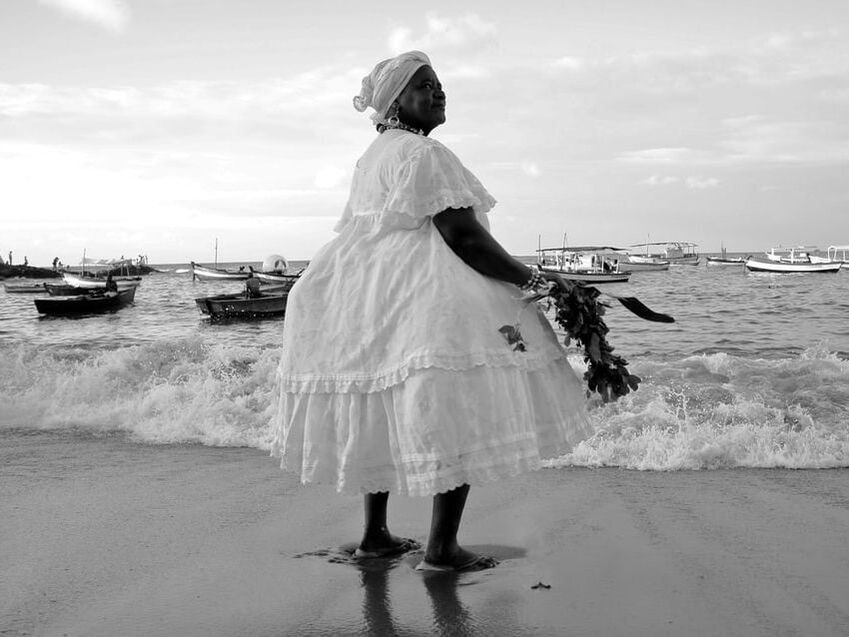
Coloniality deserves special attention to contextualise Professor Hempton’s lecture on “Women’s Networks: Opportunities and Limitations”. First, the context that overlaps historical and political elements: the year 1888. The poster at the back of Professor Hempton as he delivered the talk informed that the Gifford Lecture series dates from 1888. In the same year, Brazil declared the Abolition of Slavery – the last country in the Americas to officialise such law that is not fully put into practice as many cases of forced labour and slavery remain current.
That reminded me of so many unofficial Black women’s collectives who organised as a quilombo, favelas communities, marginalised neighbourhoods (periferias) as they created ways to resist and refuse the places that the colonial-hegemonic society imposed on them. For example, the Herstories of Dandara and Luiza Mahin. Dandara refused to be enslaved and became a quilombo leader, a warrior, agriculture worker in the initial land rights, abolitionists, antiracist and feminist movements in Brazil during the late 1600s. Luiza Mahin was a Muslim, enslaved domestic worker, strategist of one of the most remarkable pro-abolitionist revolutions in Brasil – the Malês Revolt – organised by enslaved peoples. Her Islamic, Jêje-Nago and Yoruba backgrounds are the marks of intersecting systems of beliefs that to this day are erased in the narrative about Brazil’s national identity.
Faith, race and gender operate as elements of systemic oppressions that do not accept non-Christian, non-white, non-male within the human category. The erasure is also present in how these women are considered part of the social imaginary, folkloric figures, or “just” a reminder of stereotypes around the strong Black woman, the angry Black woman. Their cause of death is unknown. Assassination and suicide are considered in the context of imprisonment and deportation.
These considerations are another trace of the permissive colonial legacy that enables racism to get away with murder. Alongside the social amnesia around the existence of Black women, their faith was also a problematic aspect that should be forbidden by the law, taken as demoniac, and led to be an underground practice, such as Candomblé and Umbanda. These religions have been the victim of hate crimes, such as intentional fire, bombing, physical and verbal attacks, with severe cases this year. Professor Hempton reminds us of the colonial legacies of Christian missions in the Global South as a presence that navigated complex values for (and sometimes against) liberation, solidarity and community building. As I reflect on the impact of such Christian missions in Brazil, and Latin America more generally, Professor Hempton offers a careful approach to not romanticise women’s agency and anti-patriarchal intentionality that does not always occur. Such critical engagement enables the counter-narratives to flow in their truth, beyond binaries but rather profound understandings of how colonial legacies operate and the potential processes to resist and flourish. It is important to remember and address to the fact that Christianity represented harmful consequences to justify slavery, genocide, taking over land and natural resources – yes, climate change is a racial matter – as new networks of women, by women and for women were organised under the umbrella of Christian institutions. As Professor Hempton pointed out, the counter-narratives from within are valid. He shows cases involving antiracist and feminist networks that made the dialogue of intersections of gender, race and class possible within Christian collectives. The movement to challenge racist-patriarchal hegemony to navigate from inside those hegemonic institutions and from outside where formal and informal collectives organise practices of refusal. As Akwugo Emejulu and Inez van der Scheer (2021) point out, “refusal is both a theory and practice that rejects the hegemonic politics and political identities imposed on racialised and colonial subjects in a given nation-state and advances an alternative politics of dissent” (year/page number?). Emejulu and van der Scheer present their work with brilliance, referring to women of colour’s collectives and activism fighting for social justice. The threads of resistance and refusal represent the constant dialogue in relation to different collectives and institutions, contexts, and ways in which coloniality is manifested. In my work with Ylê Asé de Yansã, a matriarchal quilombo community of Jejê-Nago Candomblé (referenced and rooted in traditional African-Yoruba cosmo-vision) in a rural community in Sao Paulo, Brazil, I have been reflecting on the theories and praxis for Black women’s liberation from faith. Ylê Asé de Yansã is a community fighting for land rights, anti-racism, anti-sexism, and food sovereignty for over 25 years. However, intrinsically connected with the struggle prior to 1888 and the aftermath of 1888. Moreover, it is a community in dialogue – intentionally or unintentionally – with the Christian missions, institutions and discourses. It is worth indicating the presence of white feminism in such movements that reinforced the dehumanising practices against Black and Indigenous peoples in Brazil and embraced cultural and political appropriation to erase dissident knowledge(s), faith and existence. It is a Western narrative to (re)create forms to represent Black women discursively and intersubjectively as abjects. For some collectives of white women in feminist and or Christian organisations, who also suffer from the manipulation of colonial-patriarchy, the reproduction of hierarchical account for humanity through race and class is also present. As Gail Lewis (2017) points in her article discussing “questions of presence”, it is in the flesh of Black women, the presence of black women is conjured through absence, inhabiting the shadows. Intentionally or non-intentionally reproducing and being victims of colonial-patriarchy, white women networks cause(d) harm against Black and Indigenous groups in Brazil (also globally in nuanced and contextualised ways). From this violence emerges a Black feminist reminder saying that the debate of women’s liberation is not a one-axis matter, but being constituted and constituting other elements of our identity relevant to the ways women experience harm, oppression and exclusion. As a matriarchal community, Ylê Asé de Yansã makes sure to mark their presence as a collective extrapolating simplistic understandings that place them in opposition or as antonymous of patriarchy or situate the meaning of “quilombo” as the place where runaway enslaved peoples occupied a piece of land. Voicing their truth means to be understood as agents of history, as Dandara (#sayhername), Luiza Mahin (#sayhername), and so many others women’s presence forgotten by colonial-hegemonic “Historical” and epistemological. It is the understanding that matriarchy is a universe of its own, considering contradictions but open to do the dreamwork as we move forward as community, society, humanity. It is the understanding that quilombo is a material space constituted by political values against any form of exclusion, the embodied space where everyone can carry their quilombo as they walk on the surface of the Earth marking the presence of one individual and the collective, it is the etheric space where the encounter with ancestrality and all the people from the African diaspora happens. Combining the modalities of networks Professor Hempton pointed, a quilombo – and more specifically, Ylê Asé de Yansã – is a network that has elements with religious purposes; under women’s leadership creating transnational networks and dealing with the cultural constraints and language barriers it has; challenge patriarchal views of belief systems; and promote solidarity among local communities. In this sense, it is not soley constituted by Black people but with a radical understanding that antiracist education is crucial for understanding the community and its members’ worldview. In dialogue with Hempton’s remarks is the importance of recognising that women’s networks can create spaces to fight for women’s and LGBTQI+ liberation, racial justice, and against the intersectional oppressions generated by the colonial-hegemony within and outside their networks or the values they represent. Therefore, the practice of refusal is present in the validation of erased existences, limitations and constraints, articulating possibilities to be political collectively towards new future makings of communities and societies that are yet to be created. Refusing to forget, refusing to remember as abjects of history, we repeat their names: Dandara #sayhername, Luiza Mahin #sayhername as we acknowledge their presence in the legacy of making new networks and Herstories. This lecture shed light on the challenging and urgent ways to connect the dissident existence(s) with faith in the power of refusal colonial-hegemony, so maybe we can move forward decolonising the material and immaterial spiritual, etherical – presence. May we have a safe journey. Laroyê! References Emejulu, Akwugo & van der Scheer, Inez (2021) Refusing politics as usual: mapping women of colour’s radical praxis in London and Amsterdam, Identities. DOI: 10.1080/1070289X.2021.1914951. Lewis, Gail (2017) ‘Questions of Presence’, Feminist Review, 117(1), pp. 1–19. DOI: 10.1057/s41305-017-0088-1.
Blog post by Katucha Bento, University of Edinburgh and Associate Editor of Identities
This post was part of Gifford Lecture Series 2020-2021, Lecture 5: Women’s Networks: Opportunities and Limitations. Cross-posted by RACE.ED. 
Explore relevant Identities articles:
Refusing politics as usual: mapping women of colour’s radical praxis in London and Amsterdam OPEN ACCESS On fleeing colonial captivity: fugitive arts in the occupied Jawlan Re‐scripting women's collective action: Nationalist writing and the politics of gendered memory
0 Comments
Your comment will be posted after it is approved.
Leave a Reply. |

Explore Identities at tandfonline.com/GIDE |
|
The views and opinions expressed on The Identities Blog are solely those of the original blog post authors, and not of the journal, Taylor & Francis Group or the University of Glasgow.